Monday, October 10, 2022

What Everyone Should Know About Sopranos, Altos, Tenors, and Basses

Most choirs of adult singers include four voice types: soprano, alto, tenor, and bass. Beyond "sopranos and tenors sing high while altos and basses sing low," each part performs specific functions in the musical ensemble. Beware! What follows is gross generalizations - none of these things are always true, but they generally hold true in choirs with singers of more than one gender.
Members of the Valparaiso Chorale performing at St. Mark's in 2018.
The choir includes sopranos, altos, tenors, and basses.

Four-part music
Have you ever noticed that music in hymnals usually has four separate lines to follow? There are two on the top line (treble clef) and two on the bottom line (bass clef). This is because since the time hymns began to be printed with lyrics AND musical notation, it was written for four-part music - not the organ! Each voice part is responsible for a specific line. (For a long time, hymnals only included texts. Scandal and vigorous debate ensued when someone decided to publish music and words together.)


In more modern times, hymns occasionally appear with a single vocal line. This usually means the choir (and assembly) sing the melody against a specially composed accompaniment from the organ or piano.

Sopranos
Sopranos almost always sing the melody, especially in hymn singing. When people from the assembly don't read music, they sing the soprano line. This includes bass-clef voices who sing the melody an octave down. In hymn singing, soprano notes aren't particularly high - that happens with music written for choirs to sing alone. In many church choirs, some sopranos will sing a descant - a much higher counter-melody that soars above the other singers to add interest and drama.

Altos
Altos are glue! They provide the harmonies that let us know if what we're hearing is in a major or minor key. They add harmonic colors that tell us if we're singing a hymn from northern Europe or something with a touch of jazz.


Heard by itself, the alto part is often. . .unimpressive. But what would we do without it? One young woman has achieved a certain amount of fame for recording just the alto line of the classic Christmas song "All I Want for Christmas Is You." Give it a listen at the link. It might sound odd on its own, but imagine a choir without altos. It's sad, isn't it?

https://youtube.com/shorts/-DozFTez4c0?feature=share


Tenors
There are more jokes about tenors than all other voice parts combined! Our choir room used to contain the following warning (that I will always believe was probably placed there by a tenor):


All kidding aside, tenors work with the altos to support the harmonic texture. They also add color and fullness to the choir's overall sound. (UPDATE: Since this article was printed in the Messenger, a BASS came forward and confessed to posting the sign!)

Basses
There's a reason they are called basses - they are the base of the choir! Basses normally sing a harmonized part that is usually the "root" of a chord. Basses help the rest of the choir sing in tune by providing a solid foundation. They also add richness and depth to the choral sound.

Which part do you sing?
All singers are welcome to join the Festival Choir in its work of leading the church's song at St. Mark's. Whether you sing soprano, alto, tenor, or bass, we hope you will join us. For more information, contact Tony Cruz or any choir member.

Come sing with us!

Note: A version of this article appeared previously in the St. Mark's Messenger newsletter.

Saturday, August 13, 2022

From Generation to Generation: My Experience with the ALCM at Valparaiso University


All professions have their own professional associations to help members keep up with industry trends, maintain standards of excellence, and be part of a community of people who share common goals. For Lutheran church musicians, that organization is the Association of Lutheran Church Musicians.


ALCM, a pan-Lutheran group, nurtures and equips musicians to serve and lead the church's song.

The recent conference titled "From Generation to Generation" fulfilled that mission well. This conference was sponsored and organized by Region One, but members traveled from across the country. We were eager to be in the company of colleagues and friends after two and a half years of travel restrictions and cancelled events.

For me, it was also a reunion with most of my classmates from Trinity Lutheran Seminary.

My classmates from TLS!

Held at Valparaiso University, the ALCM conference coincided with Lutheran Summer Music (LSM). LSM is the nation's premier faith-based music academy for high school students. This convergence of ALCM and LSM brought the generations of church musicians together in a way that doesn't often happen on a large scale.

Daily worship was an important part of each day. Morning Prayer in the famed Chapel of the Resurrection followed breakfast each morning. We returned there each night for Evening Prayer. LSM youth served in many of the leadership roles at these services, serving as cantors, organists, lectors, and more.


One of the most memorable events was an Evening Prayer service that included a hymn festival! Singing hymns with a full chapel was a deeply satisfying way to finish the day.

Most of the day was given to workshops. I chose three sessions on Composing/Arranging for the Assembly. I also attended sessions on choral warm-ups, bulletin design, and copyright concerns. All sessions were led by knowledgeable people who are leaders in the field of church music.

One way to inspire musicians is through concerts - and we heard two amazing groups perform.

Cantus is an American groups whose concert "My Journey Yours" told the stories of immigrants to America through reading first-person accounts. A rich tapestry of choral music, most of it by modern composers, complemented the readings.

Cantus - from the website

The second concert was by the Calmus Ensemble from Leipzig, Germany. The five singers gave an incredible all Bach, all acapella concert. It came in three parts featuring music by J. S. Bach - including sung versions of his organ works! At the center was Bach's famous motet, Jesu meine Freude.

Calmus Ensemble - from their website

Both concerts were made possible through a generous gift from Mark and Kathy Helge who are major supporters of the ALCM.

ALCM membership is one of my most valuable tools as a leader of the church's song. I am proud to serve on its board!

This mural on the chapel wall shows Valparaiso University's motto: In your light, we see light.


Monday, August 8, 2022

Music Week 2022 at Lutheridge - Good News!

Just saying the word "Lutheridge" around St. Mark's is likely to be met with smiles and happy nods. People at St. Mark's have owned homes there, attended retreats, and visited friends who live there. Our St. Mark's Ringers have enjoyed many a handbell weekend there. Lutheridge is also an important part of Pastor Daniel's call story.

Thornburg Hall - My home away from home during Lutheridge Music Week

So, you can imagine why I was excited about participating in my first Music Week at Lutheridge. It wasn't just about the possibility of cooler summer temperatures, but I had my fingers crossed! (We had great weather, by the way, with lows in the 70s and highs in the mid 80s.)

Lutheridge Music Week did not disappoint for experiences. I'll talk about three of my favorites: worship services, singing in the adult choir, and taking in the camp's natural beauty.

Most worship services at Lutheridge take place in Whisnant Chapel. The walk is not a long one, but it's quite steep. I found myself making that trek three times most days - for morning worship, an organ workshop ("Creative Song: Leading from the Organ & Piano"), and then again for evening worship.

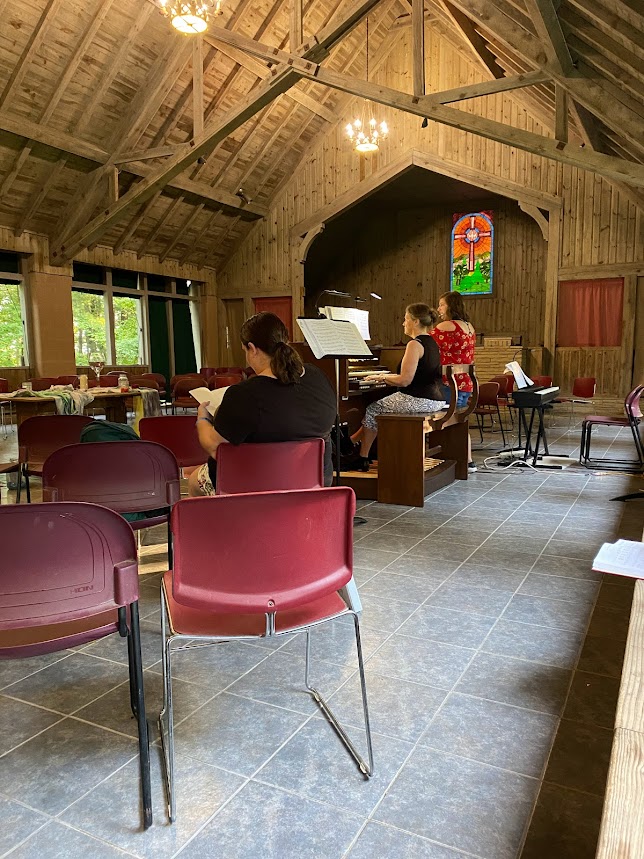
Whisnant Chapel is about as rustic as you can get. It has a simple wooden construction. Instead of windows, there are large open spaces in the wall. This allows the cool mountain breezes (and the occasional mosquito) to pass through freely.

Whisnant Chapel is surrounded by a forest of trees. No glass in the "windows."

Each worship service was well-planned and beautifully accompanied by piano and/or organ - sometimes by one person and other times by a team. (The organ is rented for Music Week.) The preaching, by Pastor Todd Cutter (University Campus Minister and Director of Spiritual Life at Lenoir-Rhyne University), was reverent and meaningful. The assembly laughed at his humorous stories - like being chased by a rooster while enjoying a morning run, and being attacked by a loft of starving pigeons.

Preparing for worship

A special communion service called for some special decorations.

One early morning worship service, accompanied by recorders and guitar, was a Thanksgiving for Baptism at the lakeside. I almost slept in for this one - after all, the walk down the hill isn't so bad, but the hike back up is another story! Fortunately, I found out I could drive there. Arriving a little early, I took a moment to enjoy nature's beauty and a wet bench. (Note for the future: take something to sit on at the lakeside!) The recorders and guitar, complemented by assembly singing, seemed like the most natural thing in the world. I'm glad I didn't miss it by sleeping late!
The lake at Lutheridge. Does anyone know if it has a name?

Handbells and preaching were part of the order of worship for Thanksgiving for Baptism.

                                                     
The biggest worship service was on Friday night with singing by the adult choir and music from the advanced and intermediate handbell choirs. It was a glorious evening!
The adult choir rehearsing for the final service.
Photo by Karol Kinard Kimmell

The highlight of the week for me occurred away from the camp. Jeremy Bankson (the organ clinician) led a hymn festival titled "Good News to Sing About." It included choral and instrumental music - most of it composed/arranged by Bankson whose organ accompaniments were dazzling! The venue was First Presbyterian Church in Asheville. My one regret for the week is that I didn't sing in the hymn festival choir.
First Presbyterian in Asheville was a wonderful place for singing hymns. 
Hymn festivals happen to be one of my favorite things.

It's been awhile since I sang in a choir. Our choir was led by Eric Nelson, Professor of Music and Director of Choral Studies at Emory University. Read his bio here: music.emory.edu/home/people/nelson-eric.html. About 65 excellent musicians sang in the choir, rehearsing two or three times each day. At first, I wasn't thrilled with all the literature he selected, but by the end of the week I had warmed up to all the pieces - and even came to love a couple of them. Singing in this choir was pure joy! We learned 5 pieces in total, and sang them all at the final worship on Friday night.

Singing under someone else's direction, especially someone as accomplished as Nelson, is a great way for a choir director to learn new approaches to leading their own choirs. Observing how another director deals with diction, singing in tune, and artistic expression is a rare and prime opportunity. I look forward to trying out a few new tricks on our Festival Choir!
A good variety of anthems to sing! I loved the Hagenberg and Craig Courtney pieces. "O For a Thousand Tongues to Sing" (Eric Nelson's own arrangement) was very stirring - especially with such a good-sized choir!

Mark Johanson (Christ Lutheran, Charlotte, NC) accompanied the choir - and he was a dream! He seemed to read the director's mind, skillfully anticipating his every move - all while playing with artistic precision!

Finally, I found some time to enjoy a walk on one of the nature trails. The one I chose has an entrance close to the chapel and is called "The Quiet Way." It was a warm day, but the mountain breezes made for a centering walk in the woods. I used to love being in the woods while I was growing up on the family farm in Wisconsin - and the North Carolina mountains made me feel right at home.


The theme for the week was "Good News!" - so let me share some good news. Lutheridge Music Week isn't just for directors! I would love to return with singers from our Festival Choir and handbell players from our St. Mark's Ringers. There are also opportunities for people who play just about any instrument you can think of.

There are also activities for children and youth. We didn't see them during the week (except during meals), but we heard all the groups perform before the week was out.

Thank you to Karol Kinard Kimmell and Ed Tompkins who serve as program directors for Lutheridge Music Week. It is a testimony to their hard work that people return year after year for this mountain top experience. I recommend Lutheridge Music Week to people from all denominations who enjoy church music or work in music ministry.
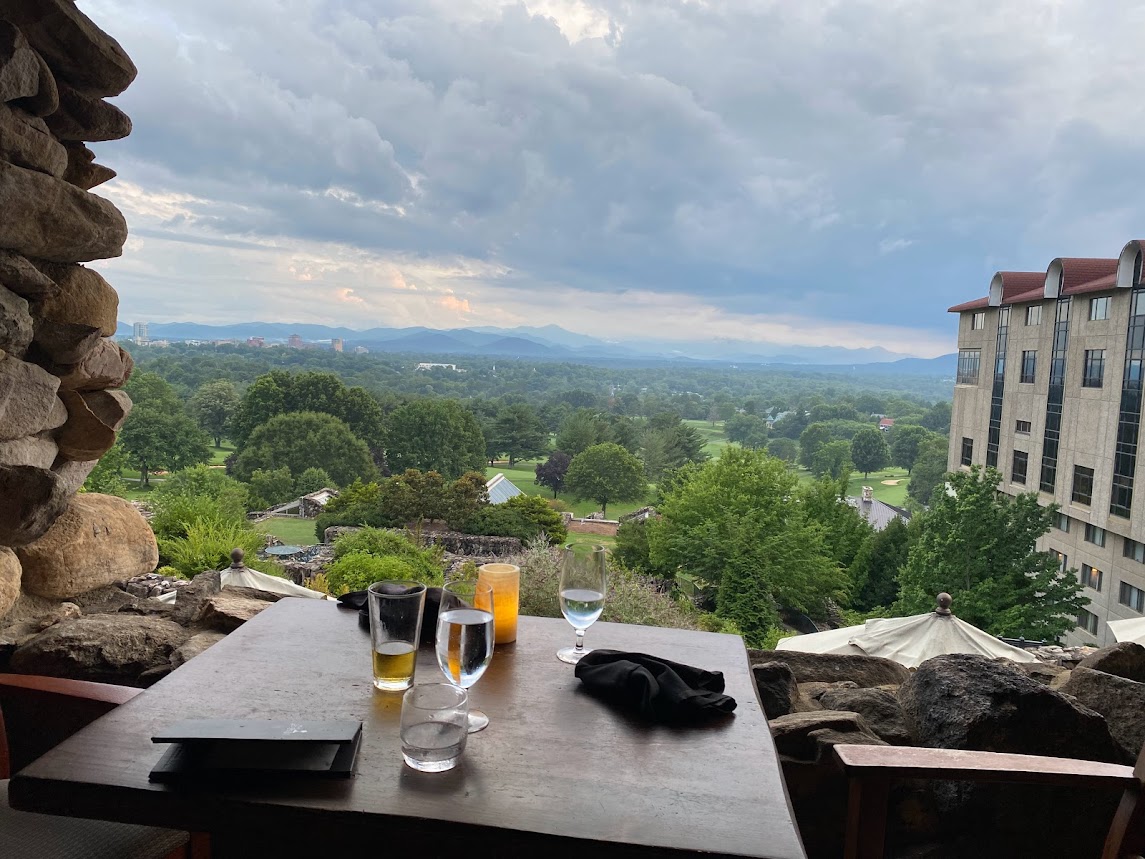
On a free night, I had a wonderful dinner with new friends at the Grove Park Inn.

Thank you also to the staff of Lutheridge for being the stewards of this special place, and for taking care of us "campers."

Thank you to First Presbyterian Church in Asheville for opening their church and organ to us. It was an amazing place to worship.

I was also grateful to have the chance to share information about the Association of Lutheran Church Musicians. Our table had free copies of past editions of ALCM's "Cross Accent" journal and "In Tempo" - a practical resource for church musicians. We also had some free cds to be enjoyed for the journey home.

Now when someone at St. Mark's talks about Lutheridge, I'll be one of those people smiling with a wistful look in his eye.


Monday, July 4, 2022

St. Mark's Just Got a Little More Accessible


                                                I recently began a quest to 
                                                find the perfect pillow.

My first pillow was too hard and I woke up every morning with a sore neck.

The next pillow had a cool groove in it for neck support. I hated it.

Another pillow was so soft that it felt like my head was just laying on the bed - what's the point in even having a pillow?


There are not fewer than five rejected pillows in my closet. I'm not thrilled with the one I'm using either.

Some things just have to fit correctly - things like pillows, office chairs, and organ benches.

Organ benches?

A too-low bench can cause tension because the organist has to consciously lift their feet and legs to avoid accidentally playing pedal notes during the gospel reading. If the bench is too high, they can't even reach the pedals to play them - and they risk sliding off the bench if they even try.

One way to adjust a bench's height is to put a block under it. It's hard to find blocks that are the perfect height - and stacking them is a safety hazard.

If more than one organist plays for a church service or a concert, it's awkward to remove and add blocks at the right time. There's no graceful, inconspicuous way to make the change.

St. Mark's recently hosted our Jacksonville chapter of the American Guild of Organists in a program with several organists - all of varying heights! Some wanted blocks and some didn't. The program, "A Plentitude of Preludes and Postludes" featured several local organists playing short pieces written for church services. 


You can view the program here: https://youtu.be/qbccPxZ-6HQ

I'm 6'3" so I like the bench to be fairly high. I've been playing with blocks, but the ones I had were not high enough. Jane Daugherty subs on the organ frequently. She is 5'5" and prefers a bench in the middle range. Another organist who subs frequently, is Patricia DeWitt. At 5'2", she likes the bench quite low.

In the United Kingdom, the Society of Women Organists has begun a campaign that asks churches and public venues to install adjustable benches for their organs. The SWO says that making the change will increase access for more women and for teenagers. They report that the average height of a male UK organist is 5'9", while the average height of a female organist is 5'3".

Katelyn Emerson (featured in an article by The Guardian), an international concert organist, adds that installing adjustable benches would help prevent injuries in all organists, regardless of their height.

SWO's campaign has three aims:
1. To give a voice to people who struggle to reach the pedals on a non-adjustable bench.
2. To advance and facilitate low-cost solutions for replacing or altering a fixed-height bench.
3. To work towards (their) ideal, in which the organ in every public venue suits people of all heights.

The media is getting their message out! Follow this link to find articles and radio programs.

https://www.societyofwomenorganists.co.uk/abc

Thanks to the St. Mark's Foundation, St. Mark's recently installed an adjustable organ bench. A simple hand crank raises or lowers the top of the bench. I couldn't be happier. Patricia DeWitt reports that it definitely helped her when she played for me recently.

Why didn't we get one at the start? Adjustable benches are expensive. At least one builder did not want to include an adjustable bench in their bid. They believed it would make their bid too high.

As I began to look for someone to build an adjustable bench, the best bid I could find was $4,000.00. Our organ technician, James Freeman was more successful. He found a bid for considerably less. Our new bench (which includes a back rest) was built by Organ Supply Industries from Erie, PA and installed on May 25th. The new bench is beautifully crafted and perfectly matches the color of the organ console.


The St. Mark's Foundation, which exists to enhance the mission outreach of St. Mark's Evangelical Lutheran Church, generously gave us a grant to purchase the adjustable bench. Thank you to St. Mark's Foundation for their generosity! It will be a tremendous help for many years to come.

It's nice to have an adjustable bench. I haven't found the right setting yet - still looking for the "sweet spot."

Still looking for the perfect pillow too.

Saturday, June 25, 2022

Have You Seen These Two Men? Peter and Paul, Apostles Commemoration on June 29


If you cannot preach like Peter, if you cannot pray like Paul,
you can tell the love of Jesus and say, "He died for all."
African American Spiritual

Peter and Paul, Apostles, are commemorated by the church on June 29th. We recall their lives and work because they point us to Christ.

They are often called "pillars of the church" since their early work helped to establish the church.

Peter by El Greco 1541-1614

Peter was with Jesus from the early days of his ministry. It was Peter who stepped out of a boat to go to Jesus on the sea - and then nearly drowned when fear overtook him. While Jesus was under arrest, it was Peter who denied him three times and then "wept bitterly." Peter's charismatic sermon brought 3,000 people into the church at Pentecost.

The Conversion of Paul
Caravaggio 1571-1610


Paul's story was different. He was not with Jesus from the beginning; instead, he persecuted the early church. Under his authority some of the early believers were executed - including Stephen. Later, Paul became a missionary to the Gentiles, carrying the gospel from its cradle in Israel. He established churches and continued to be in contact with them through writing epistles. These epistles formed much of our theology about Jesus.


You might not notice them, but you pass Peter and Paul each time you enter the nave of St. Mark's. Wooden plaques of the two saints are on either side of the baptismal font. As you enter the nave, Paul is on the left. Peter, holding the key to the kingdom, is on the right. The key is a reference to "the office of the keys" and shows us the church's authority to offer the absolution of sins.


The carvings were moved to their present location when the new nave opened in 1984. Before that, they resided in niches on either side of the altar in the old nave.

Have you ever wondered where they came from?

Pastor William Trexler has shared much history of St. Mark's with me, so he was a natural person to ask. He thought they were purchased by Pastor Biemiller. Beyond that, his only knowledge was that people used to call them "the Mexicans."

Pastor Biemiller came to St. Mark's in 1969, but the carvings can be seen in a confirmation photo from 1962. That was during the time of Pastor Nordsiek - and it means they've been a part of our worship space for 60 years. Interestingly, when the carvings are turned over, the word "Mexico" is written prominently across the back. That must be why they were called, "the Mexicans."
The confirmation class of 1962 with Peter and Paul in the background.


The two saints also looked on at the 1979 wedding of Stacey Smith.
This photo, from Erik Smith's collection, is used with Stacey's permission.

If anyone knows "the rest of the story," please let me know so I can "fill in the blanks."

This prayer is designated for the commemoration of Peter and Paul, Apostles:


Almighty God, we praise you that your apostles Peter and Paul glorified you by their martyrdoms. Grant that your church throughout the world may always be instructed by their teaching and example, be knit together in unity by your Spirit, and ever stand firm upon the one foundation who is Jesus Christ our Lord, for he lives and reigns with you and Holy Spirit, one God, now and forever. Amen.
(Sundays and Seasons)

Did you know you can comment on this blog article? Your comments are always welcome!

Sources:

By Caravaggio - Self-scanned, Public Domain, https://commons.wikimedia.org/w/index.php?curid=15219745

#smljaxart


Saturday, March 5, 2022

Something We're Not Giving Up For Lent - the Psalms!

Since we've entered the season of Lent, we have once again given up (buried) the "A" word. (I can't print it here in case the Liturgical Police are watching, but it rhymes with "What's-it-to-ya?")

One we thing we're not giving up is the psalms. In fact, we are highlighting them with new musical arrangements by Luke Mayernik. He recently wrote a collection of psalms (called a "psalter") that sets each of the Sunday psalms in a uniform collection. He titled it The Five Graces Psalter. We'll hear and sing these settings for the first five Sundays in Lent.

I've not been able to find where the name came from, but I suspect it comes from a prayer by St. Alphonsus Liguori (1696-1787). In his prayer, Alphonsus asked for five graces: pardon for all offenses, divine light, a share in God's love, confidence in the merits of Jesus Christ  and the intercession of Mary, and perseverance. Lutherans pause at the "intercession of Mary," but surely the psalter echoes these themes - minus overt references to Jesus and Mary.

The Five Graces Psalter brings together three elements.

First is the assembly refrain. The refrains are drawn from texts by the International Commission on English in the Liturgy. The ICEL prepare various liturgical texts in accordance with direction from "the Holy See." (The Vatican)

The second element is the text of the psalms themselves. They come the Revised Grail Psalms. For Roman Catholics, this is the official psalter for the English language used in their churches. In addition to translating the texts, thought was given to musical considerations so that these versions are especially suited to chanting and singing.

The third element is Mayernik's own style.  He wanted to create a psalter that would appeal to people who enjoy traditional AND contemporary music. The result is a psalter with enough musical substance for discerning ears, but also enough melodic appeal for someone who "isn't necessarily a professional musician but can carry a tune - and maybe even carry that tune throughout the entire week and sing it as a prayer. . ."

The psalms are sung like tones similar to the ones we often sing at St. Mark's. But they don't arbitrarily assign the last three syllables of a line to three specific notes. Rather, the syllables are artfully placed so that the listener has a stronger sense of a melody. The chords that accompany the melody run the gamut. They are sometimes traditional, often lush (jazzy even), and at times downright dissonant - depending on the nature of the text. This gives Mayernik's settings both harmonic freshness and melodic appeal.

Mayernik's psalms can be sung in a variety of ways - with choir or cantor/soloist, with guitar, piano, or organ.

This psalter is a beautiful addition to the church's song. We sing the psalms in a variety of ways at St. Mark's and I look forward to adding these to the mix. The Five Graces Psalter is published by MorningStar Music Publishers, part of the ECS publishing group.
Luke Mayernik - from the ECS website

sources:
A video interview with Luke Mayernik: https://www.youtube.com/watch?v=It6FNEo14Ro&t=327s
https://www.catholicity.com/prayer/prayer-for-five-graces.html
https://www.ecspublishing.com/
https://www.lukemmusic.com/home

The Greatest Passion Hymn You (Probably) Don't Know - and How We're Going to Change That

(A version of this article appears in the St. Mark's Messenger, March 2022.)
Paul Gerhardt


Repetition.
Repetition.
Repetition.

It's how we learned to write our name, use the multiplication tables, say the Pledge of Allegiance, and recite John 3:16. It's how we learned to sing our first songs. It would not be far-fetched to say that repetition is how we first learned God loves us. (Jesus love me, this I know. . .)

The change of liturgical seasons is a great time to introduce a new hymn - at least a hymn that's new to us.


During the season of Lent, we'll add the hymn A Lamb Goes Uncomplaining Forth to our repertoire of assembly song. We learn it through, you guessed it, repetition!

Paul Gerhardt (1607-1676), Germany's most famous hymn writer, wrote this classic hymn about the passion. In many congregations it is well-known and deeply loved. But it doesn't seem to be familiar at St. Mark's.

The Prayer of the Day for Palm/Passion Sunday says this:


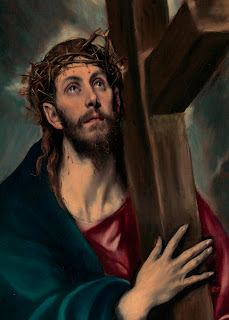
Christ Carrying the Cross - El Greco


A Lamb Goes Uncomplaining Forth expands on several points from this prayer.  The opening stanza introduces us to God's lamb, expressing his pain, humiliation, and loss as he goes to his death. The second and third stanzas imagine a conversation between the Father and the Son with Jesus agreeing to take on human form. He does this out of obedience to the Father and with profound love for us - to do what we cannot do for ourselves. The final stanza expresses that we no longer need to fear death since Christ, himself, will bring the church before God's throne where it shall remain for eternity.


Since repetition is one of the ways we can learn a new hymn, we'll hear it sung and played in a variety of ways before we sing it on Palm Sunday. You can help your learning by following along in Evangelical Lutheran Worship when the hymn is being sung.

March 6, First Sunday in Lent
A soloist sings the first stanza, followed by an organ variation by Bálint Karosi, Cantor at St. Peter's (ELCA) church in New York City.

March 13, Second Sunday in Lent
A soloist sings another stanza, followed by another Karosi setting on the organ.

March 20, Third Sunday in Lent
The Festival Choir sings the full hymn during the prelude.

March 27, Fourth Sunday in Lent
A final organ variation from Karosi.

April 3, Fifth Sunday in Lent
The St. Mark's Ringers play a handbell arrangement by Larry Sue.

Finally, on Palm Sunday, we will all sing A Lamb Goes Uncomplaining Forth as the Hymn of the Day. May it remind us all how in endless love for the human race, God sent our Lord Jesus Christ to take on our nature and to suffer death on the cross.